Showing posts with label New Orleans. Show all posts

Tuesday, April 5, 2016

The Right to Remain Silent

Some writers seem to write just to get attention.  Obviously, writing for the public presupposes on some scale that the writer wants attention.  Whether posting on a blog or publishing a novel, the writer wants people to read it.

But some writers, particularly on public forums, seem to post things just to get others riled up and to get responses from people with diametrically opposing viewpoints.

Take the newspaper forums.  In New Orleans, we have nola.com. To be honest, even the most innocuous response to a story causes a shit storm of responses on the site.

Some responses are from buffoons, for lack of a better, more technical category– you know, those people who will say anything just to cause trouble, whether they believe it or not.

They will comment on race, sexual orientation, physical beauty, weight, especially if it has absolutely nothing to do with the story. These people never progressed emotionally beyond that sixth-grade logic.  Maybe in middle school, other kids laughed at the comments because they wanted to fit in or maybe 11-year-olds really do think some of those things are funny.

Then there are the politically motivated, the people who believe politics have something to do with everything.  A typhoon just struck the Phillippines? Someone will blame the inclement weather on the Democrats or Republicans. Earthquake? Must be something George Bush did. Or Obama.

The religious zealots also crave attention in the forum world.  Don’t get me wrong, I don’t begrudge anyone wanting to offer prayers to a cause or victim.  What I find annoying are the comments like, “Katrina was a punishment from God.”  Or attempting to justify terrorists' attacks by calling it God’s will.

Do these people think they are convincing people of their viewpoint on God? Or do they just want to aggravate the crap out of everyone else?

The worst, however, are the people who have to argue an opposing viewpoint just for the sake of argument.  As a criminal appellate public defender, my job is nothing if not playing devil’s advocate, but I’ve seen people on list serves or public forums who always argue against what the masses seem to agree, even when the argument is nonsensical and unsupported by any actual evidence or facts.  These people can have no other goal than to get people to notice them.

The U.S. is a great country to live in, in part because of the rights we have.  Consequently, it’s kind of difficult to complain about someone exercising their First Amendment right to free speech.  But the Framers intent in drafting the original Constitution was actually to limit the government’s involvement and intrusion into our daily lives, not necessarily to give us extra rights.  The amendments contained in the Bill of Rights--adopted more than a decade after the Constitution was signed--was designed to enumerate specific rights the government could not infringe upon.

Interestingly, the Bill of rights also includes the Fifth Amendment, which gives citizens the exact opposite right, the right not to speak.  While it involves the invocation of the right of an individual suspected of a crime not to be forced to incriminate himself, sometimes I wish the individuals who relied so much upon the First Amendment would take a hint from the Fifth Amendment.

(As a short aside, if you ever want to get freaked out, watch a British cop show.  When they arrest the suspect, the first thing they do is ask if the arrestee wants to say anything, and advise him that remaining silent can be used as evidence of guilt.  Whoa is all I can say about that.)

Normally, commenting on public forums won’t result in criminal charges so the Fifth Amendment wouldn’t be implicated.  New Orleans is anything but normal, however, and we have had U.S. Attorneys get in trouble for commenting on public forums about pending cases under pseudonyms, so it’s always wise to be careful.

Did the U.S. Attorneys involved crave the same attention the way some buffoons and trouble makers on the forums or Facebook or Twitter seemed to crave attention?  Or did they comment in order to tip the scales at trial time, to give them a leg up in the prosecution?

 At least one federal judge seemed to think the latter was correct when he set aside convictions that he felt were influenced by the U.S. Attorneys' comments on the forums.  So commenting is not always innocuous and not always victimless.

As writers, we get attention whether that is our ultimate goal or not.  Our work should affect people, hopefully in a good way, but not necessarily so.  While everyone might not like what we’ve written, just as we sometimes might not be able to stomach comments made by racists, zealots, or just plain crazy people, it’s important to remember that our words matter, and can sometimes have effects we haven’t anticipated.

While the government prosecutors involved in the posting scheme likely didn’t realize they would eventually get in trouble for posting their comments– mainly because they made up fake names they thought couldn’t be traced– anyone who puts anything in writing, whether in a book, on a forum, or in an old-fashioned hand-written note, should realize that someone on the other end is going to read it.

As writers, we can only hope that whatever it is we’re writing has some kind of positive impact, whether it’s as big as saving the world or as simple as giving someone a break from the monotony of daily life. Otherwise, why write at all?


Tuesday, January 5, 2016

Bad Wolf Productions Indie Short Film Fest


Bad Wolf Productions is accepting short film submissions for the Bad Wolf Productions Indie Short Film Fest.  All selections chosen will be shown Saturday, February 20, 2016, at 9:00 p.m. at the Zeitgeist Theater in New Orleans, Louisiana.  A short reception will follow. 

The RULES:

1.  All entries must be received by January 24, 2016.

2.  While we prefer films of ten minutes or less so we can showcase as many films as possible, all films will be reviewed.  If your film is a masterpiece, we will not disqualify it because of length.

3.  All genres are eligible.

4.  We have no rules as far as profanity, nudity, violence, or gore, but we do have to consider what is appropriate for a public audience.

5.  All entries must be submitted via a Vimeo link, minimum requirement 720p but 1080p preferred.  The download button must be present.  If you password protect, please be sure to provide the password.

6.  The Vimeo link must be emailed to badwolfproductions@cox.net and include the name the filmmaker wants associated with the film, the city, state, and country where the film was shot, if the film has premiered anywhere and if so, where, and if it has received any awards in any film competitions. Include your password as well if your film is password protected.

7.  If your film is chosen, you will be required to sign an agreement certifying that you have all of the necessary actor, crew, music, property, location, etc. releases and have cleared anything that needs to be cleared. This must be either scanned and emailed or printed and faxed back to us by February 7, 2016. If the filmmaker is under 18, his or her parent must also sign the agreement.

8.  There is no entry fee and no fee for admission.

PLEASE NOTE:  You will receive an email confirmation within 24 hours of our receipt of the film. If you do not, please email us to verify receipt.

Notification of films accepted will be emailed and posted by January 30, 2016.


Sunday, December 22, 2013

Sex


This post was inspired by the book LEAN IN, by Sheryl Sandberg. It isn’t a review, because I haven’t actually read the book. In fact, the post was more inspired by some of the reviews of the book, which is apparently about the inequality women still face in the work force and how to overcome it.  It may even be broader than that, possibly about the inequality women face in life in general. 

It also, according to the book’s own blurb, gives examples of things women do to hold themselves back.  It seems there are some things people do that are seen as positive attributes in men but seen as negative in women.  I can guess a few–or at least, what I think would be included.  Perhaps cursing? Being direct? Standing to pee?

I am not trying to minimize the message of this book. And actually, I probably will buy it and read it because now I’m curious.  But so far, I haven’t seen myself personally affected by the inequality in the sexes in the work place.

I’ve had jobs varying from waiting tables (my first job), to dancing in a can-can show (my college job), to collecting child support (my law school job), to being an appellate public defender (my current job.)  In none of those jobs did I feel men were making more money, getting better promotions, or reaping any benefits I wasn’t by virtue of the fact that I was a woman.  In fact, some of those jobs were not even available to men, such as the can-can job.

While there was an unofficial Boy’s Club at the D.A.’s Office in New Orleans when I was a prosecutor in the late ‘90s, Boys Club is probably a misnomer.  The group of the elite was not at all limited to men.  It was limited only by one’s ability to suck up.  Thus, anyone willing to kiss enough booty would be granted privileges.

The odd thing about the elite group was that sometimes they got screwed by the bosses as an inside joke.  The two male prosecutors who sucked up the most and spent the most time hanging out with the chief ended up getting assigned, together, to the absolute worst section of court that no self-respecting attorney wanted to get stuck in–a section where the female judge was crazy.  She soaked her feet– in pantyhose, mind you– in a water-filled foot spa that made noise and attracted gnats and made the entire courtroom smell like Fritos.  Her chambers were decorated with gigantic blown-up photos of her, and she had wigs lined up on her shelves where other judges had law reference books.

Worse than all of this, she hardly ever went to trial.  The two attorneys assigned to her section were in a contest to see who could do the most jury trials that year, 100 being the ultimate goal, a goal they were not going to reach in this section.  And when a case did go to trial, it was painful, with bad rulings, long, irrational comments that had nothing to do with the case at hand, and the judge playing solitaire on her laptop and staring at herself in a handheld mirror so much she would often ask for testimony to be read back to her by the court reporter because she had missed it.

So I can’t say that any of my past jobs were impacted by the fact that I’m a woman.  It could be I was just lucky in my job choices.  But reflecting on the equality or inequality of the sexes in the area of employment has me wondering if there is any truth to the theory when it comes to writers and writing. 

Do publishers judge female writers differently from male writers when they are considering a manuscript? Do more readers tend to buy certain types of books because they believe the writer is male than if the writer is female and vice versa?  Why do some female writers use gender non-specific names than their real name? Do they know something I don’t?

I can’t imagine sexism exists in the world of book publishing and book purchasing.  But maybe there is and no one has written a book about it yet.

Sunday, October 27, 2013

Bad Reviews or Why Prisoners Like Grits


Human beings are unique individuals, with unique tastes and likes.  And dislikes.  Anyone who has ever tried to feed a child vegetables knows that everyone likes different things.  There is no universal anything that appeals to everyone.

Case in point– born and raised in New Orleans, I like seafood.  Fried, boiled, and in the case of oysters, raw.  I like frog legs and barbecue alligator.  My sister, who shared my upbringing, is a picky eater, and says she’s “allergic” to seafood, a euphemism for she doesn’t really like it.  She doesn’t eat gumbo or etouffe and when we were little girls, would eat a bowl of Fruit Loops on Thanksgiving day instead of any of the vast offerings my Cajun relatives had prepared. 

So why do we get so upset when someone doesn’t like what we’ve written?

I suppose not liking your book is more akin to someone not liking your baby than not liking your favorite color or favorite meal.  It’s so much more personal.  But really, the same logic should apply. 

Not everyone may appreciate your character’s dry wit, fondness for Shakespeare, or the rum and Coke your character needs to make it through the day.   If someone doesn’t like your character, or your plot, or even your locale, he might dislike your book.  Maybe one of your characters reminds the reader of someone he knew in real life. While it’s a great compliment that your character is that realistic, it does little too salve the wound of the reader turning on you because of it.

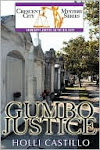
I had a girl give me a scathing review because she didn't like my character.  I still try to take it as a good thing, that she saw so much to hate in my protagonist she must have really viewed her as a real person.  Here is the link to her Amazon review, the worse review I've ever received.  http://www.amazon.com/Gumbo-Justice-Holli-Castillo/product-reviews/1892343517/ref=cm_cr_dp_qt_hist_two?ie=UTF8&filterBy=addTwoStar&showViewpoints=0

Did I cringe when I read this review? Of course. I still do.  I just cringed when I saw it again when I clicked the link above to test it to see if it worked.  It's a terrible, horrible review.  The girl was kind of mean and maybe a tad immature.  Or am I just projecting here? Either way, when things like this bother me, I keep in mind a story from my old D.A. days.


When I was a new Orleans prosecutor, the public defender in one section of court I was assigned to would let me speak to the inmates before the judge took the bench.  With their rap sheets in hand, I would go through the docket and figure out if there were any deals to be offered.  We had a huge docket, and deals were a primary way of moving it.  The D.A. has always multi-billed everyone in New Orleans, meaning we enhanced sentences based upon how many prior convictions the defendant had, similar to the 3-strikes law.  It clogged the docket and sometimes put defendants in jail for really long periods of time for relatively minor crimes.

I remember one particular defendant who had 7 prior auto burglary convictions.  That’s right, seven.  On a fourth felony conviction of ANYTHING, a defendant is looking at 20 to life.  I’m not a fan of getting my car broken into– it has happened several times in my lifetime– but I also can’t stand the thought of how much it costs to keep someone in prison for life for breaking into cars.  (Especially when I’ve seen killers walk away with much less because they had a paid attorney.) 

So after I told the defendant he needed to switch to a new crime because he obviously sucked at car burglaries, I asked him how much time would he be willing to serve if he could get a deal.  My supervisor had to approve every deal and I knew my office would still be looking for a lengthy sentence.  The defendant was a little wishy-washy, but I got him to commit to twelve years.  I thought that would be fair, if my bosses would approve it, and I could move the case.

Before we finished our discussion, the defendant looked at me earnestly and said, “Miss, you don’t know how bad it is in here.  In the morning, we get grits.  Plain grits. Not even no butter or salt or pepper, just plain grits.  I got to get out of here, even if it is in twelve years. I can’t go the rest of my life without butter and salt and pepper on my grits.”

Now I was thinking, hmmmm, I’ve never put salt and pepper on my grits before, but it sounds good. So the next time I ate grits, I tried them the defendant’s way, and they were delicious.  They were not something that would keep me going in jail for twelve years, looking forward to having them when I got out, but still good.

Grits meant way more to the defendant than they ever could to me.  Given the chance, they would not be my first choice of food, not even for breakfast, not even after a twelve-year incarceration. 

But like my defendant willing to plead guilty to twelve years so he could have his buttered grits with salt and pepper once again, readers come to your book with a host of experiences and expectations, as well as their own preferences and prejudices, which can make them hate your book or love your book.  Most of the time, you will never know the reason– you can only accept that you can’t even expect to please them all.

As for the defendant, I was moved out of the section before his next court date, (common practice at the D.A.'s Office), so I never did find out if he got the deal or not, or if he ever got his grits the way he liked them again.  Clearly, there are much worse things than bad reviews. 

Wednesday, August 31, 2011

JAMBALAYA JUSTICE

Jambalaya Justice is finally available through Amazon.com, Bn.com, independent book stores, and other websites where books are sold. I will also have some available int he near future from my website, but have to get my computer guy (translation, brother-in-law) to add the info to sell through Paypal. It's supposed to be easy to do, but for some reason I couldn't get it accomplished on the Gumbo Justice website and had to get him to do it for me. But that's what family is for, right?

In any event, I was pleased to see it is finally out, although it is not yet available on Kindle or Nook, but hope it would be soon. I saw today purely through luck that someone has already done a really nice review of the book.

Soon, I will be re-organizing my blog to include guest bloggers, interviews and book reviews, and am continuing to work on the third in the Crescent City Mystery Series, Chocolate City Justice, which is a little darker as it opens as Katrina approaches and follows the various characters through the hurricane.

And of course I'll be getting word of Jambalaya Justice out there. Hope you enjoy it.

Tuesday, May 17, 2011

Jambalaya Justice

Information on Jambalaya Justice, which is at the publishers now, due for a summer release:

The murder of a hooker in a New Orleans crackhouse is destined to become another unsolved homicide until prosecutor Ryan Murphy takes an interest in the case. Ryan has a connection to the victim and won’t back down until the murder is solved, even if it means she has to go undercover as a hooker herself and keep her fingers crossed that her detective boyfriend, Shep, won’t find out. She’s also juggling her Strike Force cases, including the prosecution of a mobster murderer, a nasty domestic violence, and the armed robbery of Big Who’s strip club. Not to mention a home invader she prosecuted is off of probation and might be following her. Being an outspoken pit bull of a prosecutor makes life dangerous enough for Ryan; trying to find a killer and hiding it from the one person who can protect her may end up being deadly.


Shep is on a secret quest of his own, investigating the identity theft of Ryan’s former best friend, Edie, who is presumed dead. As he delves further into the case, he begins to question whether Edie may still be alive and out to harm Ryan. Ordered by his captain, Ryan's father, to keep the investigation quiet, Shep not only has to lie to Ryan, but find a way to protect her from harm she doesn’t know exists. He'll also have to figure out what to do if Ryan ends up discovering the truth, because secrets have a way of getting out.


Set against the backdrop of pre-Katrina New Orleans, Jambalaya Justice is the second in the Crescent City Mystery Series, which eventually follows Ryan through Hurricane Katrina and into the strange new world of post-Katrina New Orleans.


The third in the series, Chocolate City Justice, is in progress.

Thursday, May 5, 2011

Jambalaya Justice

Just as I am finished editing Jambalaya Justice, the second in the Crescent City Mystery Series and follow up to Gumbo Justice, I saw on the news that one of the New Orleans police officers originally convicted in relation to a police-Katrina murder has had his conviction overturned and has been granted a new trial. The feds are reviewing the federal judge's decision to determine if they will re-try him or not.


I have blogged about this particular murder before. There were five officers, some rank, allegedly involved. During the aftermath of Katrina, when the police had set up makeshift district offices, a rookie sharpshooter was accused of shooting a civilian who was attempting to approach the office. Two other officers were accused of taking his body from his brother and another individual who were attempting to save him, and burning it. Another officer was accused of writing and filing a false police report and then lying to federal agents about it, and finally, a rank was accused off intentionally not tying the three separate incidents together and realizing it was a scheme to cover a murder. The sharpshooter was convicted, as was one of the officers who burned the body. The officer accused of the cover up for filing a false report was the third convicted, and the one whose conviction has now been overturned.


The last guy happens to be a friend of mine. His wife and I were assistant district attorneys together in the late 1990's. He was a police officer even then, which is how they met, and he actually arrested my brother-in-law once for possession of marijuana. Travis, the officer, always seemed to me to be a straight shooter who played by the rules. He certainly didn't offer any leeway for my brother-in-law after finding out who he was.


When Travis was convicted, I was upset. I could only imagine what his wife was going through, and while I could picture Travis following an order someone gave him, I couldn't imagine him intentionally doing something on his own like hiding the truth about a murder. But I wasn't there, and Katrina was an unprecedented event and I can't swear as to how anybody will act under those type of conditions.


When he was first convicted, I had to believe everything would work out. I am an appellate public defender now, an officer of the court, and probably lean a little hard on making sure individuals' rights are not violated. It's been my job for the past 11 years, so it's ingrained in me at this point.


In Travis' case, he has maintained from the beginning that he assisted a ranking female officer with the writing of the report, and the factual basis was not his own, but hers. She testified for the prosecution, changing her testimony more than once. She was caught in several lies, and given complete immunity as far as the murder. Immediately after her testimony, she took early retirement from the NOPD, for which she was still employed. One of the biggest issues was the original report that she wrote. She claimed the original report was altered by Travis, but for some reason she had not kept a copy of that original report. Soon after the trial, one of the acquitted officers submitted what he said was the original police report written by the female rank, which shows the report eventually submitted was not altered by Travis. The prosecution tried to argue the report was a fake, but offered no proof to that. The judge found that if the original police report had been provided to the jury, the jury would have acquitted Travis, which is the standard for newly discovered evidence. While the rank who eventually provided the report may have been holding out on providing the report, perhaps fearful he would be convicted and would need the report to get a new trial himself, his failure to provide the report, for whatever reason, was not the fault of Travis. Obviously, if Travis would have had access to the smoking gun that would have exonerated him, he would have used it at trial.


It so happens my mystery series revolves around a prosecutor and the dysfunction of the New Orleans criminal justice system, that somehow usually ends up rendering justice if not necessarily fairness or what is right. Obviously, the two concepts are not the same. Justice requires a trial without legal errors, not one that ultimately results in the guilty getting convicted and the innocent going free, although those should be desired results. The belief that only those, and all of those, who deserve punishment are punished, is childish. The law doesn't require perfection. It only requires that nobody cheats or makes a mistake during the process.


So seeing that two of the individuals involved were convicted and their convictions upheld, two others were acquitted by the jury, and one was convicted and his conviction set aside, all I can think is that the premise and theme behind my Crescent City Mystery Series is correct, that things maybe eventually do work out the way they are supposed to, even if sometimes they need a little help.

Saturday, December 11, 2010

First Amendment Project Auction

The First Amendment Project is an organization that, among other things, provides legal representation for reporters dealing with First Amendment issues. As a writer, the First Amendment is important to me, because I don't want to be censored, I don't want my children to be told they can't read certain books, and I don't want our newspapers and t.v. news to feel they can't reveal the whole truth to us for fear of going to jail or being sued. Freedom of speech has a lot of nuances, and if we take it for granted, it is only because someone once fought for us to have the right. The fight is ongoing, though, and the FAP is one group that continues to fight it.

In one of their fundraising efforts, the FAP is hosting an Ebay auction where writers are auctioning off a name in their next book. All of the proceeds go to the FAP.

I am auctioning off the naming of a character in Jambalaya Justice, which will be out in 2011, and have provided three female characters and three male characters from which the bidder can choose.

I am also auctioning off a signed copy of the book, and either a phone call, or within a year, a night of free drinks at my bar in the metropolitan New Orleans area with me and the real-life Big Who, one of the characters from Gumbo Justice and Jambalaya Justice.

The bids are not cheap, starting at $100.00, but this is really a worthwhile cause. One writer is auctioning not only naming the character in his graphic novel, but drawing the bidder as the character. The Showtime Series "Weeds," is also auctioning off the naming of a character for the t.v. show.

The writers do not make any money off of this, but I still hope every writer makes the sale, because it is such a good cause to support for writers.

Saturday, November 20, 2010

Promotion in Increments

Like most writers, I have to do my own promotion. I am published by an independent press, Oak Tree Press, and am happy that everything worked out the way it did. When I first started out, I thought I wanted a big New York house that would put me on the Bestseller's List. When that didn't work out, I looked for an agent. I also queried publishers, not really understanding the difference between publishers and agents at the time, and lucked out by getting a contract with Oak Tree, which has worked out extremely well for me.

When I was querying big houses, I didn't realize that the big houses don't keep books in print indefinitely, and that if you don't sell big from the beginning, they may pull your books. I also didn't realize that the front shelves of the Barnes and Noble are reserved for already best-selling authors, and there was no way on earth any big New York publisher was going to spend big money putting a no-name like me at the front of the book store. I was also unaware that the big New York houses wouldn't spend their hard earned money promoting me, and I would do a lot of promotion on my own if I was published by one of them.

So it turned out I signed with an indie house and as I started exploring the murky waters of promotion, I learned a lot. I was lucky enough to have a promotion mentor, Sunny Frazier, another Oak Tree Press writer, who guided me along the way, (along with other newbies she refers to as her posse)and explained the industry to me. I was a complete novice, and although I knew enough to have a website, a blog and a Facebook account, I wasn't sure about anything else, or what to do with these now that I had them. So Sunny helped me out.

One thing she didn't explain to me, probably because she figured it was self-explanatory and I should have realized it already, is that promotion is incremental. By this, I mean you have to think of new things to do constantly.

It's easy to keep waiting for that one big hit, that one thing you just know will send hundreds of thousands of people to your website or to Amazon to purchase your book. I wonder, how do I get Brad Pitt to walk around holding a copy of Gumbo Justice? He lives in New Orleans part time, so if I really wanted to find him, I bet I could. My husband was an extra in the Green Lantern movie that shot down here, and at the end of shooting he gave the director a signed copy of my novel. I just knew that I was going to hear back from him wanting the movie rights, but so far, I'm still waiting. Or maybe I'll do an interview on a website that Oprah happens to come across... You get my drift.

The more promotion I do the more I realize that promotion is like training for a marathon that never happens. I have to come up with ways to get my name and my book out there every month, and then I have to try to do it again the next month, and the next month, and the next month. If I can book an interview this month, find a new website to either list my book, post a blog, or at least make a comment, I am taking a step in the right direction. I also try to blog on my own blog, and then post about it on Facebook and Twitter at least once a month. I try not to overdo it. After all, many of my Facebook friends and Twitter buddies already know about my book, and although they may want to read an interesting blog I've written, they don't want everything I write to be Gumbo Justice or my experiences as a writer.

I have found that when I do get my name out there, whether in an online interview, or my college alumni magazine, I make a few book sales. I don't make mega sales each time, maybe one or two a day for a few days. But if I do this a few times a month, I sell more books.

Then comes next month, and I have to find something new. This is where it comes in handy to have friends and a mentor in the field. They pass on new websites, new places to post, other writers looking for someone to guest blog. I try to get to a few of these each month.

Of course, as I've mentioned, the marathon never actually happens. All of the training doesn't culminate in one big event--my book hadn't made the Bestseller's List and hasn't been optioned for a screenplay or cable t.v. series. But I do sell a few books, I do get emails from strangers asking when the next one will be out, and I do feel like my work is being read and enjoyed, which is probably the most important thing to me.

So while my incremental promotional tactics may not result in millions of dollars of sales, more of my books do get sold, and more importantly, read, than if I wasn't self-promoting. And with my second novel, Jambalaya Justice, coming out soon, the promotion I've done for Gumbo Justice should pay off double.

Sunday, October 31, 2010

New in New Orleans

A few months ago I wrote an article about New Orleans slang for AOL. I saw the assignment on Red Room, a website for writers and readers, and there was a huge selection of New Orleans articles that needed to be written for AOL Travel. I chose the one on New Orleans slang because it fit me so well.

"New in New Orleans," provides a list of ten essential New Orleans' expressions, including a few tips to not only help you fit in like a local, but to help keep you safe when visiting the Big Easy.

You can read the article read at http://news.travel.aol.com/2010/10/26/new-orleans-slang/


Gina Misiroglu of Red Room put me in touch with the AOL people, which is one of the many ways she directs traffic to Red Room and points a spotlight on Red Room's authors.

Wednesday, September 1, 2010

Hurricane Katrina Anniversary- Part 3

This is the last segment of the Hurricane Katrina Anniversary. If you post a comment on any of my Katrina blogs, you will be entered in a drawing for a signed copy of Gumbo Justice. I will be doing the drawing over the weekend, and will post the winner then.


Katrina Anniversary Bog- Part 3

Two close friends of mine stayed in New Orleans for the hurricane, coincidentally, each the Godfather of one of my daughters. Both had very different experiences.

Danny stayed at his house in mid-city. His house was raised, and didn’t flood. After a few days without electricity, he would have left, but an elderly neighbor who lived around the corner from him refused to leave, and he wouldn’t leave her behind. The police and National Guard tried to strong arm him into leaving, but he had provisions and was happy to stay and watch over his belongings and his neighbor. He ventured out frequently. With no electricity, it was the darkest dark he had ever seen. Gunshots were frequent. Occasionally, bodies floated by, including one in a police uniform. There was little to be done with no phone service, no way for police to retrieve the bodies, and no place to put the bodies until they could be carted away for autopsy.

Robbie also stayed behind, in his house in Lakeview, on Canal Boulevard, a street name that would prove to be appropriate after the 17th Street Canal failed. Robby, like Danny, had the means to leave. Unlike Danny, Robbie didn’t have a neighbor to look out for, but did have a cat, and cats weren’t welcomed at shelters or most motels. When Robbie’s house began filling with water, the first thing he did was grab his cat and put her in a cat carrier. He ended up swimming back and forth in his driveway with the cat carrier over his head, until he finally made it to a set of raised railroad tracks.

From the tracks, he tried to retrieve his furniture, now floating past him. He managed to save a few pieces and put them on the tracks, but it was pointless. He ended up leaving it all behind anyway. He also saw people floating by, screaming for help, beginning to drown. He tried to help them, but they were too far away from the tracks, and there was nothing he could do. He ended up making a very long trek to the Superdome, through water up to his chest, holding his cat above his head.

Outside the Superdome, he was greeted by an eerie sight- a line of cats and dogs, sitting and staring, confused, waiting to be retrieved by their hopeless owners who felt forced to leave them behind. When he tried to enter the dome, he was told he could not bring his cat in, nor would he be allowed to bring her with him when the buses showed up to evacuate people. So he left, and went to Danny’s, not prepared to relegate his Fluffy to that line of sad, abandoned cats and dogs waiting for masters who would never come back for them.

Danny’s elderly neighbor eventually agreed to leave, and when she did, Danny left as well. The safety issues were less important to him than the comfort issues, and he was ready for civilization again. He managed to contact someone by text message to meet him on the interstate, and he walked. Robby also eventually met up with his family in Baton Rouge, where he spent some time in the hospital, covered with boils from a staph infection he caught from the flood waters. He was one of many treated for what they were terming Katrina rash.

I returned home exactly 2 weeks after the hurricane to minor roof damage, with working electricity and water service. Phone service and cable took a little longer, but we got them back pretty quickly. I was more isolated back home with no t.v. or cable for a few days than I had been in Houston, and it was an uneasy time. Only a few men in our neighborhood had returned, and had not brought their families back yet, and my two girls and I were pretty much alone all day while my husband, a contractor, supervised a team from Texas repairing roofs. There was a silence like I had never experienced. Ours was the only air-conditioner running, and then when the cable service was restored, the only t.v.. We had to drive two hours to Thibodeaux to find a grocery that was stocked with meat and other freezer foods, and where we didn’t have to wait in line an hour just to get in the door.

The smell was sometimes overwhelming, whether from moldy refrigerators, the rotten food everyone had to bury in their backyards, the stagnant water that had yet to drain from some neighborhoods, or the corpses that had yet to be removed from the flood. Flies the size of small birds came from nowhere, but were particularly nasty at the gas stations for some reason. Gas was another thing we had to wait in line for, and it was a good idea not to go anywhere if you couldn’t gas up near home, because you never knew if gas would be available at the next station. Debris was still a danger, clogging the streets and puncturing tires, and power lines were still down in many areas.

Driving around the un-flooded sections of town was odd. Very few cars on the roads, curfew at dark, and near the area of the breach, the streets were gone, the houses either destroyed or moved by the wall of water. Where streets once sat was nothing but sand. An occasional street sign had not been destroyed, and provided a vague landmark. Houses were crushed, others sat in the middle of what had once been the street.

Stories of shootings and rapes were still prevalent. Some of these were certainly tall tales, or exaggerated versions of true stories, but some of the stories were true, and were covered up, or at least denied to the media. One particularly sad and chilling story was of local icon, Charmaine Neville. She ended up commandeering a bus and driving a busload of people out of the city after the flood, but not before saving herself and a neighbor from the rising waters only to be raped by a stranger trying to get to higher ground. She is certainly not alone in her tragedy.

It should come as no big surprise that mental health issues increased, exacerbated by the fact that most of the mental health facilities either did not reopen, or were closed down after they did because of lack of funding. Murder/suicides also increased, especially domestic.

I definitely didn’t have it as bad as some people, although my way of life was affected. I relied upon public assistance for the first time in my life, receiving food stamps for a two month period as well as a check from Red Cross, something I never would have thought I would need to do. While my credit card companies would wait for payment, the bank for my mortgage and car note expected any shortage to be made up in the next three months, as opposed to tacking the missing payment on at the end of the loan. Why they thought any of us would be in a position to pay extra in the coming months, when many people were out of jobs, is beyond me, but it wasn’t worth not paying it now if I could, instead of having to find extra money a month from now. Not knowing what the future was going to hold, I didn’t want to take the chance. So my Red Cross check went to bills and the groceries were paid for, so until my husband actually got paid– some people needed to wait for insurance claims to pay him– we made due. Unlike most of Louisiana, for some reason FEMA denied me payment. I must have filled out the forms wrong on the internet, but I helped my mother fill hers out and she received her money without a problem, so I’m not sure what happened.

Katrina was definitely a shock to all of us, but we tend to focus on all the bad things that happened– the lack of government reaction, the way some of our police turned into murderers, the way some of our citizens stole big screen t.v.’s on National Television. As a city, we have a lot to be ashamed of.

On the other hand, the good stories don’t make the papers. For every thug who looted a store for a gun, there is a decent person who pulled a stranger from raging flood waters. For every cop who shot an unarmed person in error, there is one who saved a baby from a roof. And for every doctor who overdosed a terminal patient on morphine, there is a guy who refused to leave until he made sure his neighbor was safe.

Ultimately, if you view the lowest point in the life of any person or any city as a tragedy unfolds, you’re going to see a lot of ugly. Hopefully, those who actually experienced it will be able to show the good as well. And God forbid if such a scenario repeats itself, we will all know what to do next time.

Holli Castillo

Sunday, August 29, 2010

Hurricane Katrina Anniversary- Part 2

August 29, 2005


The television in our hotel room never went off the day Katrina made landfall. I knew it was probably not good for my two girls, but it was the only news we could get. We watched the tracking on the national news channels and the weather channel, as Katrina stealthily approached. She wobbled every so often, but we were experienced enough with tracking storms that we recognized it for what it was, and knew by the next hourly update, she would be back on course. And she was.


The day before, my kids had been bored. We hadn’t brought toys, because we left sort of on the fly, not believing we would be gone for that long, but after only one day, the girls wanted to play. I took them to the hotel lobby, which had a small pond with two swans in it, and to the hotel restaurant, which had a creepy balloon man I still think was a pedophile. The girls sensed something was wrong with him and my youngest hid his substandard balloon animal in the closet until she decided to pop it. I warned them he might be the bad man we've talked about, and to stay away from him. I didn't have to tell them twice.

We also went to the Galleria. I felt blessed when the Disney store had 40 percent off of everything for Katrina evacuees with an I.D.. Not knowing how long we would be gone, I didn’t how far my bank account was going to stretch, something I hadn’t considered before we evacuated. The room wasn’t cheap, anywhere from $99 to $179 per night, depending upon what day of the week, and I was putting it all on my American Express card. I didn’t know then that a little thing on my insurance policy called “loss of use,” would reimburse me, although not in time to pay the bill.

My husband was a contractor, if he didn’t work, he didn’t make money. I have a contract through the state to do criminal appeals, but I had no idea if I would get paid if I wasn’t actually working, and I couldn’t work from Houston. I didn’t worry a whole lot yet, though. Something inside kept me believing it wasn’t going to be as bad as the newscasters were making it out to be.
My husband arrived from New Orleans early Monday morning, in the wee hours, before Katrina hit land. He brought my laptop, and it became my lifeline to the world back home. I connected with NOLA.com, our local newspaper’s website. They have excellent forums for people to communicate with each other and post news, and eventually to post requests for news about missing people, but at first there was nothing to report. My husband and family slept while I watched the news and surfed the internet looking for information.

Early in the morning, we saw the first images from the French Quarter. The worst we saw was a few bricks from the top of an older building had fallen on a car. There was not a lot of flooding, and the wind damage was not as bad as it could have been. New Orleans East had been hit the hardest in the metropolitan New Orleans area, as the storm had made landfall further east than tracked. Slidell, Louisiana, took a huge hit, as did Bay St. Louis and the coast of Mississippi. We felt somewhat relieved.

My husband called one of our neighbors, who was a police officer and had stayed in town. The neighbor, Mike, said we had a little flooding, he and a few other men who had stayed behind pulled debris from the drainage system and the flooding went down. Part of one of my trees had been destroyed, and all of our roofs had damage, but it didn’t sound too bad.

About an hour later, new reports began coming in. Water was rising in the French Quarter from an unknown source. People began arriving at the Superdome, the “shelter of last resort,” with stories of massive tidal wave type flooding, people trapped on roofs of houses, screaming for help, others drowning, swept up in the water.

The first levee that I heard had failed was at the 17th Street canal. My daughter’s school was two blocks away from this canal. Many of her new friends lived in this neighborhood. Through Nola.com, I learned the school was okay, but only because our sheriff’s department sandbagged right along the canal, keeping a lot of the water from going into Old Metairie. New Orleans, particularly Lakeview, and the less affluent areas of Metairie, were flooding.

The time line actually was something like this:

At 4:30 a.m., the Industrial Canal leaked through drainage gates into neighborhoods on both sides of the I-10, creating a minor flood compared to what was to come.

At 6:10, Katrina made landfall at Buras, Louisiana, and a wall of water 21 feet high crossed the Mississippi river levees, flooding Plaquemines Parish.

At 6:30 a.m., the tidal surge built in the Intercoastal waterway and the levees were overtopped, sending St. Bernard under water.

At 9:00 a.m., the surge in the London Avenue Canal rose, the levee panels began bending, and water began leaking into yards, creating a minor flood.

At 9:30 a.m., the east side of the same levee failed, putting parts of Gentilly under water.

At 9:45, the 17th Street canal levee wall panels failed, filling mid-city, Lakeview, and parts of Metairie with water.

At 10:30, the west side panels of the London Canal failed, adding 8 feet of water to the already flooded Gentilly.

Then we heard the Mississippi River Gulf Outlet, or MRGO as we call it, a shipping channel, had levee failure, flooding more of New Orleans. The MRGO crosses the Industrial Canal or Intercoastal waterway, and goes through St. Bernard. The Industrial canal connects the Mississippi River to Lake Pontchartrain, separates New Orleans East from the rest of the city, and divides the lower 9th Ward from the Upper 9th Ward. The failure of the levees of MRGO and the Industrial Canal caused the bulk of the flooding portrayed on t.v. and movies, but the 17th Street Canal caused the Lakeview and mid-city flood, while the little known London Avenue Canal caused the decimation of Gentilly.

These canals lead from the river to the lake. Because of the levee failures, Lake Pontchartrain would continue filling the city until the amount of water outside the lake leveled off with the amount of water inside the lake. That's a whole lot of water.

The day Katrina hit, I spent the entire day back and forth between the computer and the front desk of the hotel. I had only booked the room until Monday, that day, and the hotel said they were overbooked and didn’t know if they were going to be able to let us stay. I had to continuously check with them, while frantically trying to book another room elsewhere in Houston. Unfortunately, Houston was pretty full up with New Orleans people right then.

My mother and I got in a tiff because she complained I spent too much time on the computer and not enough taking care of my children, which I guess she kind of failed to realize was part of the reason she was there. I wanted to yell at her to do something, anything, to help us out. Take the kids for lunch or find us another room or something, but I guess she was so used to having everything done for her she couldn’t even contemplate taking the lead. It was driving me crazy. We were all worried about the condition of our homes, our neighborhoods, wondering if our lives would ever go back to normal, but I was also worried about where we would be spending that night, and the only way I had of checking that out was on the computer. She snipped ALMOST under her breath that she was just going to leave and go rent a car (because of course she rode with me instead of taking her own car), and book her own room and stay somewhere else. I wanted to ask how she was getting to the rental car place, and how was she going to book a room, particularly since there were none available, but I dismissed her bitterness as her own nerves. (I was almost tempted to ask her for half of the money for the room she had already stayed in before she left, at least until I received my insurance check, but that was me being ugly and my frustrations coming to a head.)

The hotel would never commit to more than one day at a time the whole two weeks we were there. Before Katrina, during a category 1 hurricane called Cindy in July, I had decided to start looking for an evacuation house, something no more than 5 or 6 hours away from home, so we could travel to it when necessary, but far enough away to be safe from hurricanes. I had looked in parts of Louisiana after Cindy, but had kind of let it slip my mind until now. I vowed during that hotel stay that no matter what else I did that year, I was going to get an evacuation house, and would never go through that again. I did end up buying an evacuation house the following February, in the hills of rural Northern Alabama, and have never regretted it.

Eventually, we got the room worked out, and the day after Katrina, my husband, his father, and his brother decided they were going to be cavemen and go home and brave it, with no electricity or running water. No one was allowed back in town yet, but my husband is a deputy constable, and badged his way in to town. They all lasted a single night without a/c, but my husband did manage to clean out the two maggot-infested refrigerators at my house as well as my mother’s. Cell phones were still not working in the area, but text messaging was, so we were able to communicate while he was gone.

Our house had roof damage, in my daughters’ playroom and my office, but only a few toys, children’s books and small appliances were ruined. My husband and his entourage came back a day later, and we remained in Houston for nearly two weeks.

My husband went home a day before we did, but I was extremely apprehensive. We were still hearing stories of looting and gunshots, although a lot of that had stopped with the national guard in town, but that brought a series of other problems, such as a curfew at dark. It was particularly scary because police from all over Louisiana, as well as the rest of the country, were in town, in uniforms, trying to keep the peace. But that also meant any impostor could don a police uniform and pretend to be an officer.

My daughter’s Godfathers stayed for the storm, both with different experiences of what happened during Katrina, and will be highlighted in part three, as well as how our life changed after Katrina.