Showing posts with label Jambalaya Justice. Show all posts

Tuesday, April 5, 2016

The Right to Remain Silent

Some writers seem to write just to get attention.  Obviously, writing for the public presupposes on some scale that the writer wants attention.  Whether posting on a blog or publishing a novel, the writer wants people to read it.

But some writers, particularly on public forums, seem to post things just to get others riled up and to get responses from people with diametrically opposing viewpoints.

Take the newspaper forums.  In New Orleans, we have nola.com. To be honest, even the most innocuous response to a story causes a shit storm of responses on the site.

Some responses are from buffoons, for lack of a better, more technical category– you know, those people who will say anything just to cause trouble, whether they believe it or not.

They will comment on race, sexual orientation, physical beauty, weight, especially if it has absolutely nothing to do with the story. These people never progressed emotionally beyond that sixth-grade logic.  Maybe in middle school, other kids laughed at the comments because they wanted to fit in or maybe 11-year-olds really do think some of those things are funny.

Then there are the politically motivated, the people who believe politics have something to do with everything.  A typhoon just struck the Phillippines? Someone will blame the inclement weather on the Democrats or Republicans. Earthquake? Must be something George Bush did. Or Obama.

The religious zealots also crave attention in the forum world.  Don’t get me wrong, I don’t begrudge anyone wanting to offer prayers to a cause or victim.  What I find annoying are the comments like, “Katrina was a punishment from God.”  Or attempting to justify terrorists' attacks by calling it God’s will.

Do these people think they are convincing people of their viewpoint on God? Or do they just want to aggravate the crap out of everyone else?

The worst, however, are the people who have to argue an opposing viewpoint just for the sake of argument.  As a criminal appellate public defender, my job is nothing if not playing devil’s advocate, but I’ve seen people on list serves or public forums who always argue against what the masses seem to agree, even when the argument is nonsensical and unsupported by any actual evidence or facts.  These people can have no other goal than to get people to notice them.

The U.S. is a great country to live in, in part because of the rights we have.  Consequently, it’s kind of difficult to complain about someone exercising their First Amendment right to free speech.  But the Framers intent in drafting the original Constitution was actually to limit the government’s involvement and intrusion into our daily lives, not necessarily to give us extra rights.  The amendments contained in the Bill of Rights--adopted more than a decade after the Constitution was signed--was designed to enumerate specific rights the government could not infringe upon.

Interestingly, the Bill of rights also includes the Fifth Amendment, which gives citizens the exact opposite right, the right not to speak.  While it involves the invocation of the right of an individual suspected of a crime not to be forced to incriminate himself, sometimes I wish the individuals who relied so much upon the First Amendment would take a hint from the Fifth Amendment.

(As a short aside, if you ever want to get freaked out, watch a British cop show.  When they arrest the suspect, the first thing they do is ask if the arrestee wants to say anything, and advise him that remaining silent can be used as evidence of guilt.  Whoa is all I can say about that.)

Normally, commenting on public forums won’t result in criminal charges so the Fifth Amendment wouldn’t be implicated.  New Orleans is anything but normal, however, and we have had U.S. Attorneys get in trouble for commenting on public forums about pending cases under pseudonyms, so it’s always wise to be careful.

Did the U.S. Attorneys involved crave the same attention the way some buffoons and trouble makers on the forums or Facebook or Twitter seemed to crave attention?  Or did they comment in order to tip the scales at trial time, to give them a leg up in the prosecution?

 At least one federal judge seemed to think the latter was correct when he set aside convictions that he felt were influenced by the U.S. Attorneys' comments on the forums.  So commenting is not always innocuous and not always victimless.

As writers, we get attention whether that is our ultimate goal or not.  Our work should affect people, hopefully in a good way, but not necessarily so.  While everyone might not like what we’ve written, just as we sometimes might not be able to stomach comments made by racists, zealots, or just plain crazy people, it’s important to remember that our words matter, and can sometimes have effects we haven’t anticipated.

While the government prosecutors involved in the posting scheme likely didn’t realize they would eventually get in trouble for posting their comments– mainly because they made up fake names they thought couldn’t be traced– anyone who puts anything in writing, whether in a book, on a forum, or in an old-fashioned hand-written note, should realize that someone on the other end is going to read it.

As writers, we can only hope that whatever it is we’re writing has some kind of positive impact, whether it’s as big as saving the world or as simple as giving someone a break from the monotony of daily life. Otherwise, why write at all?


Sunday, July 5, 2015

Writing and Editing

I spent the better part of yesterday editing one of my novels that is already in print. A reader complained that the novel was poorly edited. There was one glaring typo in it, which I won't point out in case other readers haven't found it. But the reader also indicated a misuse of the word "there" in place of the word "their."  I went through the manuscript and used the 'find' feature to locate every time the words  "there" and  "their" were written and found they were all used correctly.  So the reader either is unaware of the correct use of the words herself, or she was just being spiteful.

I don't think one typo--which is actually a real word, just not the word it was supposed to be--constitutes horrible editing.  I have a publisher. My books are edited. We try our best not to let anything sneak through the cracks.  That being said, even the best editor  or publisher or writer in the world can miss a word.

Our brains tend to make sense of the words we see on the page, whether they are misspelled or not.  This means it is difficult to make sure that any manuscript is one hundred percent perfect.

So now I am looking back through both of my published novels and trying to make them perfect to have my publisher in effect re-publish them.  I am also working on the third and fourth books in the series, trying to make the story, which was originally going to take place in one book, less complicated by stretching it over two. 

And then I will rewrite, edit, have it edited, and it will be published in two parts, Chocolate City Justice Part One and Part Two. 

And they may not be perfect. A typo just may get through.

Hopefully, my readers will enjoy the story anyway.

Saturday, May 24, 2014

THE JUSTICE DEPARTMENT AND TAPED CONFESSIONS

For those whose writing includes police procedure, particularly in the area of confessions or police interviews, there is new policy out there just decided by the Justice Department, that requires certain federal agencies, such as the FBI, DEA, ATF, and Marshals Service, to use electronic recording to video record "interviews" of suspects.

Keep in mind, this is on a federal level, not state level. Every state agency has its own procedures for conducting interviews.  The procedure and policy may vary from jurisdiction to jurisdiction within each state, and may even vary among departments in the same jurisdiction.  For instance, New Orleans has 8 police districts.  Each district may handle its confessions and statements differently, and the different departments in the same district (usually in the same police station) may even have different policies on taking statements.  The homicide division in one district may record all statements taken, while the burglary division in the same district may say they don't own a tape recorder.

The U.S. Constitution requires that statements used against a defendant be voluntary and free from coercion and duress.  It does not require that they be recorded.

The Justice Department has now decided to videotape statements taken from suspects, unless there are extenuating circumstances that prevent it.  (Sounds like a loophole to me, but I'll skip it for now.)  This decision has both positive and negative ramifications.

First, on the positive, it will be difficult for a defense attorney at trial or on appeal to argue that a suspect was beaten or threatened into giving a statement or confession if the whole thing is on tape.  Juries will also be more inclined to convict if they see the defendant admit guilt for themselves.

On the other hand, a suspect who is ready to spill his guts may change his mind in the time it takes to set up the video or audio recorder.  He may have time to think and change his story, or he may have time to decide to ask for an attorney.

There are two caveats to this rule.  As I mentioned above, if it is not going to be easy to get the equipment, such as in cases when a defendant confesses at the crime scene and not in an interrogation room, it may not be practical to haul a video camera out.  (Although with cameras and video in cell phones these days I'm not sure that is a valid excuse not to record a statement.)

Second, a suspect has the right to refuse to have his statement recorded.  This also has implications.  A suspect can claim he didn't make the statement and that's why it's not recorded.  On the other hand, if a suspect doesn't make a statement, or if law enforcement wants to twist his words around, the agent can always say the suspect refused to be taped.

For those who write about federal agents, this can be a new twist or curve in the road when a suspect confesses or gives a statement.  I can picture stories with videotaped confessions that go missing, juries who don't believe the agents that the defendant made the statement but refused to be taped, and agents who really do beat confessions out of suspects and consequently don't tape the statements.  Anything to keep the reader guessing as to what actually happened.

With the new Justice Department policy, writers should at least allude to videotaping or audio taping the confession if one is made to a federal law enforcement officer in the novel , especially if the confession is important to the story and a videotape or audiotape of the statement is not going to be presented. 


Sunday, December 22, 2013

Sex


This post was inspired by the book LEAN IN, by Sheryl Sandberg. It isn’t a review, because I haven’t actually read the book. In fact, the post was more inspired by some of the reviews of the book, which is apparently about the inequality women still face in the work force and how to overcome it.  It may even be broader than that, possibly about the inequality women face in life in general. 

It also, according to the book’s own blurb, gives examples of things women do to hold themselves back.  It seems there are some things people do that are seen as positive attributes in men but seen as negative in women.  I can guess a few–or at least, what I think would be included.  Perhaps cursing? Being direct? Standing to pee?

I am not trying to minimize the message of this book. And actually, I probably will buy it and read it because now I’m curious.  But so far, I haven’t seen myself personally affected by the inequality in the sexes in the work place.

I’ve had jobs varying from waiting tables (my first job), to dancing in a can-can show (my college job), to collecting child support (my law school job), to being an appellate public defender (my current job.)  In none of those jobs did I feel men were making more money, getting better promotions, or reaping any benefits I wasn’t by virtue of the fact that I was a woman.  In fact, some of those jobs were not even available to men, such as the can-can job.

While there was an unofficial Boy’s Club at the D.A.’s Office in New Orleans when I was a prosecutor in the late ‘90s, Boys Club is probably a misnomer.  The group of the elite was not at all limited to men.  It was limited only by one’s ability to suck up.  Thus, anyone willing to kiss enough booty would be granted privileges.

The odd thing about the elite group was that sometimes they got screwed by the bosses as an inside joke.  The two male prosecutors who sucked up the most and spent the most time hanging out with the chief ended up getting assigned, together, to the absolute worst section of court that no self-respecting attorney wanted to get stuck in–a section where the female judge was crazy.  She soaked her feet– in pantyhose, mind you– in a water-filled foot spa that made noise and attracted gnats and made the entire courtroom smell like Fritos.  Her chambers were decorated with gigantic blown-up photos of her, and she had wigs lined up on her shelves where other judges had law reference books.

Worse than all of this, she hardly ever went to trial.  The two attorneys assigned to her section were in a contest to see who could do the most jury trials that year, 100 being the ultimate goal, a goal they were not going to reach in this section.  And when a case did go to trial, it was painful, with bad rulings, long, irrational comments that had nothing to do with the case at hand, and the judge playing solitaire on her laptop and staring at herself in a handheld mirror so much she would often ask for testimony to be read back to her by the court reporter because she had missed it.

So I can’t say that any of my past jobs were impacted by the fact that I’m a woman.  It could be I was just lucky in my job choices.  But reflecting on the equality or inequality of the sexes in the area of employment has me wondering if there is any truth to the theory when it comes to writers and writing. 

Do publishers judge female writers differently from male writers when they are considering a manuscript? Do more readers tend to buy certain types of books because they believe the writer is male than if the writer is female and vice versa?  Why do some female writers use gender non-specific names than their real name? Do they know something I don’t?

I can’t imagine sexism exists in the world of book publishing and book purchasing.  But maybe there is and no one has written a book about it yet.

Saturday, November 23, 2013

Imagine

A friend recently read a Facebook status I posted and commented that she wished I could live inside her brain.  It made me realize that the distinction between writers and non-writers isn’t just that we write things other people don’t, but that we see the world differently.

I hear a chainsaw break through the sound of the wind chimes hanging from my porch one blustery, chilly morning.  My dogs stop, stare at the window, emit low growls.

My sister would dismiss this whole scene as a neighbor working on his house and tell her dogs to shut up.  To me it’s a psychopathic killer, making his way house by house, killing anyone he finds. He uses the chainsaw to cut through the front doors he can’t break into or kick down.  And then–

If you’re a writer, you can imagine what comes after the “and then.” 

As writers, nothing we see, hear, or otherwise experience, can be taken at face value.  A speeding driver isn’t just an obnoxious danger to the road–he is a spy on a mission, a man rushing to the hospital to see the birth of his son, a robber eluding police.
That light moving through the sky is a Delta Airlines plane to some people.  To a writer it is a spaceship from another universe, the plane of a super hero or super villain, or an experimental, top secret mode of military transportation being tested.

To a writer, a cigar is never just a cigar.  Even Freud might be surprised at everything a cigar could be or might mean to a writer.

It isn’t just wild imagination that sets us apart–if that were the case, 2-year-olds  would be excellent writers.  It’s seeing realistic possibilities within our wild imaginations and being able to describe it and share it with others, to give these possibilities form, a plot, characters, and if we do it right, a theme, the whole raison d’etre of our work.

I don’t think my friend would really want me living in her brain. I think it would scare her to see things the way I see them.  Or possibly make her slightly schizophrenic, the way I sometimes feel.  But I really wouldn’t mind sharing some of my imagination with her, especially when I hear a thump and start imagining all of the possibilities that I know my friend can not.
If I can’t share my brain, at least I can share the crazy ideas that I can formulate into my stories, and hopefully entertain people in the process.  And if not, at least my life never seems as boring as it actually is.


Saturday, November 9, 2013

Things That Go Bump in My Mind

I’m in the middle of writing Chocolate City Justice.  Actually, I was nearing the end, when I realized this mystery novel was missing a big something– a good mystery.

The book takes place during Hurricane Katrina, bringing my protagonist, Ryan Murphy, through the storm.  It also brings my entire cast into post-Katrina New Orleans, which is something I felt needed to be done.

The problem was when I planned the book, it was more about Ryan surviving Katrina, including drug dealers, bad cops, and the storm itself.  The mystery, however, wasn’t as well thought out as I had intended.

I did have a basic plot.  But basic plots are not my style and they definitely aren’t what the types of readers drawn to my type of writing would be looking for.  So I had to rethink, reformulate, re-outline, and revamp the entire plot.

Once I had a more involved plot and subplots, I realized I still didn’t have the suspects out there for the readers to contemplate.  I also hadn’t figured out how exactly Ryan solved the mystery, especially during the middle of a hurricane, stuck in a flooded out house with no electricity, no electronics, and all of her most prized personal belongings– everything she had taken in an attempt to evacuate– at the bottom of what would now be nicknamed Lake Gentilly.   
Gentilly is a New Orleans neighborhood where Lake Pontchartrain crashed through two canal breaches and flooded the houses. A lot of people think the flooding from Katrina was confined to the Ninth Ward– the area portrayed in the HBO Treme series and in just about every other Katrina-inspired movie and t.v. show.  
But the flooding in New Orleans was not confined to just one area of the city and wasn’t caused just by one levee breaking.  In Gentilly, which is where the University of New Orleans is located, the London Avenue Canal that pumped rain water into Lake Pontchartrain was breached in two different spots.   I used to live in this neighborhood, and the house I used to live in was raised four feet from the ground and still flooded to the 8-foot mark on the house. It is just a few blocks from the breach.

So taking all this into account, I had to figure out how to add some more suspects, put them earlier in the book when there was a better chance Ryan could at least partially solve the mystery before ending up in the storm, and then come up with a new twist for the ending.  The twist, to me, is the most important part of the entire book. 

So I’ve spent the last few weeks figuring out what needs to be added and what needs to be changed, and hopefully, now that I’m back on track, Chocolate City Justice will soon completely exit the dark recesses of my mind and inhabit a bookstore near you (or a page on Amazon.)

Sunday, February 24, 2013

Sneak Peek Sunday- Chocolate City Justice

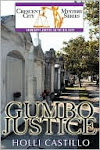
As part of Sneek Peak Sunday, I have posted the first ten sentences from Chocolate City Justice, the third in the Crescent City Mystery Series scheduled for release by Oak Tree Press this summer.  The mystery series revolves around a female prosecutor in New Orleans, Ryan Murphy.  The first two novels, Gumbo Justice and Jambalaya Justice occur pre-Katrina, while Chocolate City Justice takes place during the hurricane, as Ryan gets trapped in the city when she misses the window to evacuate.  


The boom-boom of the bass from the tricked-out orange Hummer creeping through the New Orleans Ninth Ward should have served as a warning. The Hummer was jacked up from the tires, with spinning rims and a gold chain vanity frame around the license plate that said just as much about its owner as the music selection did. If a song whose only lyrics repeated kill the po-po two hundred times could be considered music.

An abandoned lot on the corner was set up with a portable turkey deep fryer, a boiling pot of crawfish on a hot plate, and a fold-out card table displaying a hat-box size pink and white birthday cake with a black Disney princess figure on top.

The children jumping in the purple castle-shaped spacewalk in the lot continued to laugh and scream, oblivious, but the adults should have noticed and been on alert as the boom-boom grew louder, the Hummer pausing at the intersection before making the corner.  The forty somewhat people hanging out, peeling crawfish, and drinking liquor out of green bottles and silver cans must have thought they were safe during the day.

Gang members were like vampires–even the Ninth Ward Warriors couldn’t kill in the daylight.

A black woman who could have been anywhere from 20 to 40 called, “Come see here, Tanisha, and show your teeths before we do your cake.”

A girl of six with a head full of braids was instantly at the woman’s side, smiling wide, exposing four missing front teeth.  A split second later, a smaller version of Tanisha edged her way next to the woman and tugged on her arm with an even bigger smile than her sister’s.

The orange Hummer stopped.


For more previews by other authors, visit http://www.sneakpeeksunday.blogspot.com/ and click on the links.


Monday, September 3, 2012

Waiting for Isaac while remembering Katrina

Waiting for Isaac While Remembering Katrina

Once again those of us in New Orleans are watching a hurricane, waiting to see if Isaac is going to show up at our doorstep or pass us by.  We've been here before, watching and waiting.

In 2005, we did the same for Katrina. Only then we really didn't think it was going to hit. While we evacuated, we brought only enough clothes (and diapers, because I had two little ones) for a long weekend. We left on a Saturday, before a mandatory evacuation had been called.  We planned on returning home Monday or Tuesday, believing deep in our hearts that a hurricane would never hit us.

My mother, my two daughters, and I stayed at the Embassy Suites in Houston. Houston was THE place for New Orleans people to evacuate. Most of us vacationed there frequently, a sort of home away from home.  Our hotel had swans in the lobby, which tickled my children, a clown who made balloon animals, which terrified me, and was something like 40 steps away from the Galleria shopping mall, which thrilled all of us.

By the end of it, we were there for two weeks. Two weeks in a nice hotels sounds like fun, but it really isn't. Especially when you've made your husband join you at the 11th hour and he's brought along his younger brother, which infuriated your mother (who is a little odd to begin with), and you have no idea if your house is still standing or not.

The hurricane made landfall on Monday. Everything seemed fine until the levees broke. We watched CNN and the Weather Channel in horror as the city filled with water.  My husband went home on Tuesday. As a deputy constable allowed to go back into the city before the general public.  He soon texted us-- there was no other viable form of communication at the time--that our house was fine, some roof damage, a few books and toys wet, but otherwise okay.  Same with the rest of the neighborhood.

We went back two weeks later, when the electricity was back up and a few stores had reopened. Two weeks after that my daughter's school reopened.  A few months later our neighbors started coming back with their families. For months it was mainly only men working on their houses and law enforcement.

Law enforcement was everywhere. Local police, police from other parishes, police from other states, even the National Guard.  It was hard to feel unsafe with so many police personnel everywhere.  You literally could not drive a block without seeing some type of police officer.

While the police weren't able to protect us from the giant flies that took over for several months, and couldn't prevent the maggots in our refrigerators when we got home, at least we didn't have to worry about copper being stolen from our homes when we were inside them, nor of someone breaking into our homes and doing God knows what to us, as had happened to many unfortunate women during the actual hurricane.

So now, seven years later, we are in the position once again to decide should we stay or should we go. Today is Sunday. The storm will hit Tuesday in the middle of the night or early Wednesday morning.  Wednesday will be the one year anniversary of Hurricane Katrina.  Scary.

So my thinking, with a now 10-year-old and 13-year-old, and now having an evacuation house, I will probably leave.  The big difference this time is that I'm not dreading leaving, because I've faced the most uncertainty a person can face having dealt with Katrina and its aftermath.

I'm looking forward to visiting my vacation house in the hills, and while I will worry about what is happening back home, I will also use the time, and more importantly, the emotion, to write more of my third novel.

Chocolate City Justice takes place during Hurricane Katrina, bringing my protagonist, Ryan Murphy, into the present days. So everything I learn about that happens, especially if the hurricane hits, will be more fodder for my novel and jog my novel about what happened back then.  As I am planning what I will pack, Katrina is not seven years ago for me, but right now, while I am loading my car with the things I want to save should a worst case scenario occur.  And I will use it as much as I can, extracting as much good as I can from a potentially bad situation.  

NOTE:  I scheduled this to post a week after I wrote it, hoping by the time it is posted I will know how this has turned out, one way or another.

Wednesday, August 15, 2012

A Rose by Any Other Name Would Smell...

A Rose by any other name would smell as sweet.  The famous phrase from Romeo and Juliet, where the two star-crossed lovers discuss whether it makes a difference that Juliet is a Capulet and Romeo is a Montague.  They seem to think it doesn't.  We all know that it did, or they wouldn't both be dead by the end of the play. That Shakespeare may have been on to something.

Turn to the big debates over the distinctions between traditional houses, small presses, indie publishers, self-publishing, vanity presses, e-publishing, and print on demand, or POD.  Ultimately, does the public care which category a book falls into before they decide to make a purchase? And do readers even know the distinction?

For a brief explanation- traditional houses are generally those big New York publishers who rarely take on new clients, but publish and promote writers such as James Patterson and Stephen King. 

Small presses, formerly known as independent presses, are smaller publishers who perform much in the same way as the larger houses in that they do not charge authors any types of fees to be published, and take on all the expense of the book publication, such as printing costs and cover art.

The distinction between big houses and small presses are: big houses are able to get books into brick-and-mortar book stores easier, and are able to spend big bucks on the promotion of big writers. Small houses tend to use print on demand, which simply means the books are not printed until someone orders them. Small houses may or may not offer advances. Both large and small presses should pay quarterly earnings to its writers, but every contract is different.  Both do have contracts. 

The title "indie publishers" which used to represent the small houses now is used almost exclusively for self-published.  Sometimes, the companies that offer these services call themselves a name that sounds like a traditional or small press. The big distinction here is that the companies that self-publish do not edit the works they publish, but basically provide a means for the writer to get his or her book in print, as it is.  Promotion is left entirely to the writer.  Vanity presses are basically a method of self-publishing for the author, but frequently charge extremely high fees.

E-publishing is electronic publishing. It is done by most if not all publishers.  There is a huge market for e-books with Kindle and Nook, and probably the IPAD by now. Books can also be downloaded onto computers or smart phones. The benefit to the buyers is that e-book are generally cheaper, and more portable. An avid reader can save as many books as his device has memory.

Print on demand again is not a form of actual publishing, but a method to print hard copies of books. It is more ecologically friendly and green than printing vast numbers of books that may not get sold.

So, does it really matter which of the categories a book falls into? Does anyone care if a book has a big New York publisher behind it, a smaller press,  or if the writer published the novel on his own?

As a writer with a "small house", I expect my opinion will be different than someone who self-published, or a writer with a traditional, big New York publisher. The truth is that writers are going to side with the method in which they were published. It's the nature of the beast. Most of us need reinforcement as writers that we are actually "real" writers, so our way has got to be the best way.

But turn to my sister, who is "only" a reader, you know, one of those people who actually buys lots of books just to read them and entertain herself. She doesn't care if it's Doubleday, Bantam, Fly-by-Night, Small Press U.S.A., or Look, Mom, No Hands, who published the book. She cares about whether the book has a compelling story that holds her interest, good characters, a good and satisfying ending, and maybe on occasion, price.

But those things may be affected by how the book was published.  While I have seen errors in books put out by the New York publishers, those companies do have the wherewithal to do a whole lot of editing if a book needs it. Does this mean their book will be better than a self-published book that is professionally edited? Probably not. It does mean that if Stephen King has an off day of writing, nobody will be the wiser because his errors will be caught by an editor and fixed before it gets in print.

Small presses may have in-house editors, or they may expect their writers to have their work edited by an outside source, such as a writing group, a college professor, a paid editor or the like.  Small presses may also have people who perform more than one duty for the company who may assist with editing.  They generally will not publish books full of errors because those books tend to not sell well, and small presses need to make as much as they can off each author and each book. Small presses tend to keep their books available longer, because by using POD they didn't waste a whole bunch of money printing books no one will buy.

As far as self-publishing, the degree of editing depends entirely on the writer.  Some writers may self-edit their manuscripts to the point of near perfection. Others may pay a professional editor. Still some may not do any of the above and end up publishing crap.  Hey, sometimes crap sells. 

In the end, writers own prejudices will decide what books they buy, and whether it makes a difference to  them how the book was birthed.  But for the general reading public, it probably isn't going to matter how the book saw the light of day. If a reader buys any book that turns out to be full of typos, plot holes, or other errors, regardless of how it came to be published, chances are the reader won't buy a second book by that author. And that will ultimately be what causes the downfall of that writer.

So does a rose by any other name smell as sweet?  All other things being equal, probably. But a rose that hasn't been properly cared for while in the ground won't bloom the same way as one that has, and almost certainly won't smell the same.  (In case you missed it, the analogy was that poorly edited manuscripts stink. Did that come across or does this post need more editing?)

Saturday, June 23, 2012

Libraries

I finally got my novel into the public library in New Orleans. This was a big deal to me, being that my novels are set in New Orleans, and being that I was born and raised in New Orleans, lived here my whole life, and still live here.  I would have thought the New Orleans Public Library would have been happy to have the novels of a local author, set in New Orleans, in the library.

This was not the case just a year ago. I emailed the acquisitions division of the library, which is what the website says to do if you are a writer or a publisher.  I explained who I was, my credentials, and provided a short summary of both books.  I made sure I mentioned I was published by Oak Tree Press, because I wasn't entirely sure if the library accepts self-published novels, and wanted to make them aware I had a real publisher.

I didn't hear back from them.  Despite the fact that the library system to this day is still recovering from Katrina, the website mentions that they received so many donated books they either sell most of them or donate them to a group that sells them.  So it wasn't a guarantee that even if I donated the books to them, they would put them on the shelves for the public.

Maybe I should have mentioned then that the public library system in Jefferson Parish, the unofficial sister parish to New Orleans, has 11 copies of my first novel and 3 or 4 copies of my second novel.  Maybe I should have mentioned that although I was agreeing to donate several copies of my novels to the New Orleans library, and send them at my own cost, the Jefferson Parish Library had purchased all of the books on their own, without me contacting them and without my knowledge that they had purchased them.  Maybe I should have mentioned a small town in north Alabama also has copies of my books, because I have an evacuation house there.  But I didn't.

Until last week.  I am nothing if not tenacious, so I emailed the library again, this time mentioning the facts above, as well as the third book, Chocolate City Justice, would be out before year's end.

I don't know if it was just luck, the fact that Jefferson Parish carried my books, or that my next book was called Chocolate City Justice (which seems to catch people's attention), but whatever it was, the acquisitions department emailed me back within a day and asked for two copies of each book.

It may seem silly that I worked so hard to give away four books, but I have a few reasons I think are pretty good for wanting my books in the N.O. library.  First, despite the fact that I have two books published by a reputable, if smaller, publishing house, and a contract to continue with the series, I still feel the need to legitimatize myself as a writer, particularly to people I actually know.  I don't know why, except maybe I believe those that know me will not think of me as a "real" writer.  Having books in the public library makes me more legitimate.

Second, I can refer people who aren't certain about buying my book, or who I know really can't stretch their budget to buy a book, to the library.  If they enjoy it, they may eventually end up buying the others in the series when they are able. 

Third, if enough people check out my book or request my book at the library, the library may buy more copies, and may purchase the series as it is published.

Fourth, I can consider doing a reading or an event, especially with another mystery writer, at the library if my book is already there.

As much as I hate to admit it, my town is not a reading town.  Most people I know don't even get the newspaper, much less read books.  And I'm talking about a lot of educated professionals.  Some people even brag about the fact that they never read, as if that's a good thing, so getting my books into the hands of those that do read is a big deal to me.

While everyone wants to make as money as possible, the way to do that as a writer sometimes involves giving something away for free.  The bigger picture is the more people who are exposed to my books, the more books I will eventually sell.

And if I never become rich off of this gig, at least I made a modest sum doing what I love, and not everyone can say that.

God bless the public library system. 

Friday, January 6, 2012

Chocolate City Justice

With the book launch of Jambalaya Justice barely over, I finally had some time over the break to work on Chocolate City Justice. My publisher recently contacted me about a possible July release day, to time it to coordinate with the PSWA writer's conference, a conference in Las Vegas I try to attend every year.

The deadline was a little short, so I suggested a release date later in the year, but the question did bring working on the novel back into my focus again. I mainly worked on retooling the outline, something I'm still in the process of doing.

When I write, I do an initial outline. I then start writing, and after several chapters I realize it's missing something, whether it's one of the secondary plot lines, a supporting character, a scene, whatever it is, I go back and modify the outline.

Right now, I have the initial outline and about 30,000 words written, but I've had to change the outline and in doing that realized a few issues that have to be resolved. So I've stopped the forward progress of actually writing the novel to tinker with the outline and make the story better.

This is a process I'll do several times before the book is ready to go to my publisher. So while it won't be ready in July, it should be ready before the end of 2012.

In between the writing and the retooling the outline, I'll continue to promote Jambalaya Justice and Gumbo Justice until I can announce the release of the third in the series.

Friday, December 16, 2011

Jambalaya Justice Book Launch Party

I am finally having the book launch party for Jambalaya Justice, Saturday, December 17, at our bar, the Last Stand, 424 Destrehan in Harvey, LA. I say finally because the book was actually out in July, although we had it pulled once for some minor issues and re-issued. A few copies went out with the "issues", but I wanted to wait until the final version was out in hard copy and Kindle to officially launch the book.

Time kind of got away from me, as it has a habit of doing. I try to figure out where all the hours of the day go, and I can't seem to do it. I do keep busy with my youngest daughter's school as PTO president. Very busy. I also spend much of time on what I call my "job-job", criminal appeals for clients I get appointed to represent. Then I write legal articles every week for a publisher on Helium.

Oh, and did I forget to mention I write books? Not to mention have two kids, a husband, a cat, a dog, and some fish. Now I think I see where all the time goes, although I think I work on too schizophrenic of a level to categorize the time spent or put it on a chart.

I'm working on Chocolate City Justice right now. The third in the Crescent City Mystery Series will take Ryan, my protag, directly through hurricane Katrina. It kind of brings back bad memories, writing the book, but when I see how far we've come since then, it does tend to make me feel a little bit better. At least we don't have those post-Katrina flies the size of birds any longer. (My cup-still half full.)

Sunday, October 23, 2011

Emerging Novelists

I'm excited today to be featured on Emerging Novelists, a site that features, well, emerging novelists. It sounds so much better than unknown author or something like that. The interview is at http://emergingnovelists.com/Interviews.html and the background info is at http://emergingnovelists.com/index.html

Interviews are a part of promotion, and it's difficult sometimes to know how much of your personal life to reveal to strangers. On one hand, you want to be interesting, so you want to make sure you mention those things that will make readers want to read your books, but you also don't want to put your entire life on display for the world to see.

Fortunately, the most interesting things about me are public record. No, I don't have any convictions, although that certainly would make me seem more interesting. But I was in a serious head-on collision with a drunk driver, something people find notable. I also own a bar in the metro N.O. area, which sounds a whole lot more interesting than it is, although it does provide ideas for some pretty interesting characters.

So while I didn't reveal any deep, dark secrets, hopefully I provided enough personal and background information to draw a reader's attention.

Friday, October 7, 2011

Interview on Morgen Bailey's Blog

An interview for Jambalaya Justice is up at Morgan Bailey's blog at http://wp.me/p18Ztn-Xf
Morgan Bailey is an extremely nice person and an excellent interviewer. She has a way of making an interview spring from the page and not sound so, well, interview-ish. I have not yet had the chance to read any of her writer, but hope to soon.

There is also an excerpt from the third in the series, Chocolate City Justice, which is in progress.

On to another topic, my contest winner, Pamela Briggs, who won the naming of a character in Jambalaya Justice (she picked a stripper), and who I now consider a friend, visited me in New Orleans a few weeks back and I have to say we had a fantastic time.

I was a little nervous not knowing what to expect, wondering if she would run out of our bar screaming, thinking we were insane. I don't know is she thinks we're crazy or not, but she didn't run out and we had a great time talking about family, mysteries, reading, and our rival football teams. It's amazing how much you can have in common with someone you've never met who lives all the way across the country. I can't wait for her and her husband two come visit us again. (And Pam, I finally got my copies of Jambalaya Justice with the new cover, so I'll be sending out your copy soon if you're reading this!)

Now I am busy working on promoting, as well as writing Chocolate City Justice, working on my cases for my "job-job", writing legal articles for my other "job-job", and doing what I need to as president of my youngest daughter's school co-op (similar to PTA or PTO.)

I can always sleep when I'm dead.

Wednesday, August 31, 2011

JAMBALAYA JUSTICE

Jambalaya Justice is finally available through Amazon.com, Bn.com, independent book stores, and other websites where books are sold. I will also have some available int he near future from my website, but have to get my computer guy (translation, brother-in-law) to add the info to sell through Paypal. It's supposed to be easy to do, but for some reason I couldn't get it accomplished on the Gumbo Justice website and had to get him to do it for me. But that's what family is for, right?

In any event, I was pleased to see it is finally out, although it is not yet available on Kindle or Nook, but hope it would be soon. I saw today purely through luck that someone has already done a really nice review of the book.

Soon, I will be re-organizing my blog to include guest bloggers, interviews and book reviews, and am continuing to work on the third in the Crescent City Mystery Series, Chocolate City Justice, which is a little darker as it opens as Katrina approaches and follows the various characters through the hurricane.

And of course I'll be getting word of Jambalaya Justice out there. Hope you enjoy it.

Tuesday, May 17, 2011

Jambalaya Justice

Information on Jambalaya Justice, which is at the publishers now, due for a summer release:

The murder of a hooker in a New Orleans crackhouse is destined to become another unsolved homicide until prosecutor Ryan Murphy takes an interest in the case. Ryan has a connection to the victim and won’t back down until the murder is solved, even if it means she has to go undercover as a hooker herself and keep her fingers crossed that her detective boyfriend, Shep, won’t find out. She’s also juggling her Strike Force cases, including the prosecution of a mobster murderer, a nasty domestic violence, and the armed robbery of Big Who’s strip club. Not to mention a home invader she prosecuted is off of probation and might be following her. Being an outspoken pit bull of a prosecutor makes life dangerous enough for Ryan; trying to find a killer and hiding it from the one person who can protect her may end up being deadly.


Shep is on a secret quest of his own, investigating the identity theft of Ryan’s former best friend, Edie, who is presumed dead. As he delves further into the case, he begins to question whether Edie may still be alive and out to harm Ryan. Ordered by his captain, Ryan's father, to keep the investigation quiet, Shep not only has to lie to Ryan, but find a way to protect her from harm she doesn’t know exists. He'll also have to figure out what to do if Ryan ends up discovering the truth, because secrets have a way of getting out.


Set against the backdrop of pre-Katrina New Orleans, Jambalaya Justice is the second in the Crescent City Mystery Series, which eventually follows Ryan through Hurricane Katrina and into the strange new world of post-Katrina New Orleans.


The third in the series, Chocolate City Justice, is in progress.

Thursday, May 5, 2011

Jambalaya Justice

Just as I am finished editing Jambalaya Justice, the second in the Crescent City Mystery Series and follow up to Gumbo Justice, I saw on the news that one of the New Orleans police officers originally convicted in relation to a police-Katrina murder has had his conviction overturned and has been granted a new trial. The feds are reviewing the federal judge's decision to determine if they will re-try him or not.


I have blogged about this particular murder before. There were five officers, some rank, allegedly involved. During the aftermath of Katrina, when the police had set up makeshift district offices, a rookie sharpshooter was accused of shooting a civilian who was attempting to approach the office. Two other officers were accused of taking his body from his brother and another individual who were attempting to save him, and burning it. Another officer was accused of writing and filing a false police report and then lying to federal agents about it, and finally, a rank was accused off intentionally not tying the three separate incidents together and realizing it was a scheme to cover a murder. The sharpshooter was convicted, as was one of the officers who burned the body. The officer accused of the cover up for filing a false report was the third convicted, and the one whose conviction has now been overturned.


The last guy happens to be a friend of mine. His wife and I were assistant district attorneys together in the late 1990's. He was a police officer even then, which is how they met, and he actually arrested my brother-in-law once for possession of marijuana. Travis, the officer, always seemed to me to be a straight shooter who played by the rules. He certainly didn't offer any leeway for my brother-in-law after finding out who he was.


When Travis was convicted, I was upset. I could only imagine what his wife was going through, and while I could picture Travis following an order someone gave him, I couldn't imagine him intentionally doing something on his own like hiding the truth about a murder. But I wasn't there, and Katrina was an unprecedented event and I can't swear as to how anybody will act under those type of conditions.


When he was first convicted, I had to believe everything would work out. I am an appellate public defender now, an officer of the court, and probably lean a little hard on making sure individuals' rights are not violated. It's been my job for the past 11 years, so it's ingrained in me at this point.


In Travis' case, he has maintained from the beginning that he assisted a ranking female officer with the writing of the report, and the factual basis was not his own, but hers. She testified for the prosecution, changing her testimony more than once. She was caught in several lies, and given complete immunity as far as the murder. Immediately after her testimony, she took early retirement from the NOPD, for which she was still employed. One of the biggest issues was the original report that she wrote. She claimed the original report was altered by Travis, but for some reason she had not kept a copy of that original report. Soon after the trial, one of the acquitted officers submitted what he said was the original police report written by the female rank, which shows the report eventually submitted was not altered by Travis. The prosecution tried to argue the report was a fake, but offered no proof to that. The judge found that if the original police report had been provided to the jury, the jury would have acquitted Travis, which is the standard for newly discovered evidence. While the rank who eventually provided the report may have been holding out on providing the report, perhaps fearful he would be convicted and would need the report to get a new trial himself, his failure to provide the report, for whatever reason, was not the fault of Travis. Obviously, if Travis would have had access to the smoking gun that would have exonerated him, he would have used it at trial.


It so happens my mystery series revolves around a prosecutor and the dysfunction of the New Orleans criminal justice system, that somehow usually ends up rendering justice if not necessarily fairness or what is right. Obviously, the two concepts are not the same. Justice requires a trial without legal errors, not one that ultimately results in the guilty getting convicted and the innocent going free, although those should be desired results. The belief that only those, and all of those, who deserve punishment are punished, is childish. The law doesn't require perfection. It only requires that nobody cheats or makes a mistake during the process.


So seeing that two of the individuals involved were convicted and their convictions upheld, two others were acquitted by the jury, and one was convicted and his conviction set aside, all I can think is that the premise and theme behind my Crescent City Mystery Series is correct, that things maybe eventually do work out the way they are supposed to, even if sometimes they need a little help.

Sunday, April 10, 2011

Blog Talk Radio Show

Monday, April 11, 2011, at 1:00 p.m. CST, I am participating in a Blog Talk interview at http://www.blogtalkradio.com/, with Sylvia Dickey Smith. The focus of the interview is writing strong female characters, and I will be talking about writing Ryan Murphy, my protagonist from Gumbo Justice, and the soon to be released Jambalaya Justice.

The interview is thirty minutes long, and you can call in to chat or ask a question at 1-347-843-4128. (Not a toll-free number.) If you miss the interview, it will be played twelve hours later, and then archived so you can listen to it whenever you would like.

I have been interviewed on t.v. before, not as a writer, but as a parent, and I HATE the way I sound in a recording-- like a ten-year-old boy. I had to think long and hard and push myself to decide to do this interview because of that, but in the end I thought the topic was so interesting, strong women, that I couldn't stand to pass it up. (I don't believe I am nearly as strong as Ryan, who would have signed up without a moment's hesitation. Of course, her voice is prettier than mine.)

In any event, it should be interesting.